
Every year, enormous volumes of material that could be reused instead end up in a landfill. Byproduct left over after consumer use, residue from agricultural production, and material generated during food and beverage processing are all wet, bulky, and inconsistent — and unprocessed, they’re costly to store, transport, and dispose of. Too inconsistent in moisture content or particle size to be sold or reused, landfill becomes the default, and value that could have been recovered is buried instead.
Traditional processing compounds the problem. Dehydration and particle size reduction — drying and milling — are typically treated as two separate operations, each requiring its own equipment, energy source, and footprint. For companies managing waste across multiple sites or multiple material types, that adds cost and complexity at every stage, and often makes recovery uneconomical altogether, even when the material itself has real value.
One Process for Nearly Any Waste Stream
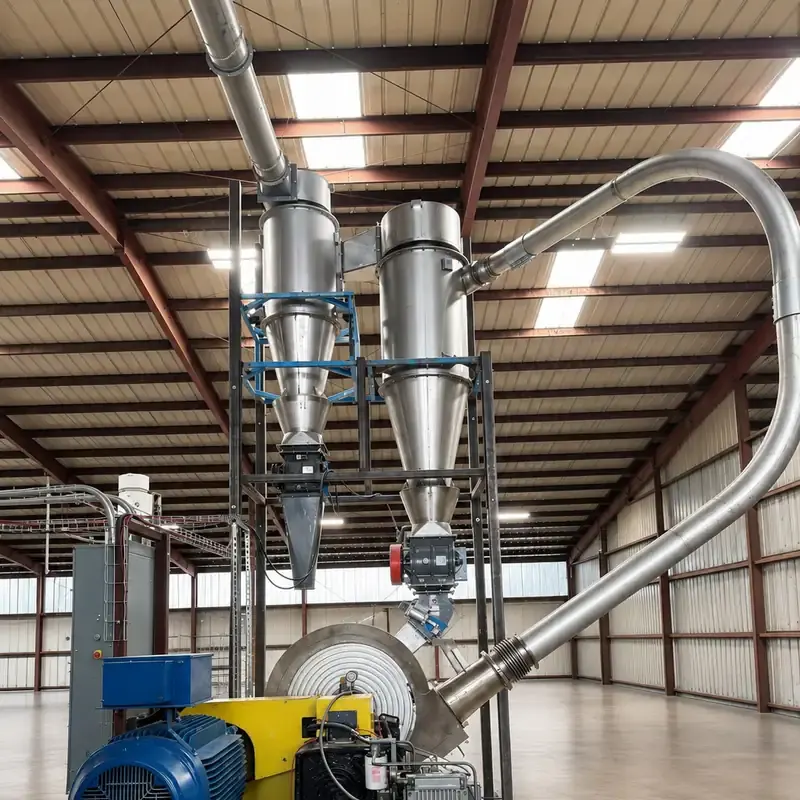
Shockwave’s technology combines dehydration and micronization — drying and particle size reduction — into a single, continuous process, transforming wet, bulky, or inconsistent waste into a stable, uniform, value-added material. The result: material that would otherwise be landfilled is diverted, stabilized, and turned into something that can be sold, not just disposed of.
The same core platform adapts across a wide range of feedstocks — from post-consumer materials to post-agricultural residues and post-food byproducts — giving processors one technology capable of turning multiple waste streams across an operation into value, instead of cost.
How the Technology Works
- 01FeedRegardless of source or composition
- 02DryHalt spoilage, reduce odor
- 03MillConsistent particle size
- 04RecoverStable, uniform material
- 01FeedRegardless of source or composition
- 02DryHalt spoilage, reduce odor
- 03MillConsistent particle size
- 04RecoverStable, uniform material
Feed — Waste or byproduct material enters the processing system, regardless of source or composition.
Dry — Moisture is removed through dehydration, halting spoilage, reducing odor, and preparing the material for handling and storage.
Mill — As the material dries, it is simultaneously micronized to a consistent, application-specific particle size.
Recover — The finished product exits as a stable, uniform material — diverted from landfill and ready for packaging, storage, or reuse.
Have a waste stream you want evaluated?
Why It Works Across Waste Streams
- Divert material from landfill and put it back into the economy
- Dehydrate and micronize in a single continuous process
- Reduce equipment, energy, and operating complexity
- Produce a consistent, stable, sellable material
- Adaptable across post-consumer, post-agricultural, and post-food waste
- Scalable to a wide range of volumes and facility types
Built for Post-Consumer, Post-Agricultural, and Post-Food Waste
Post-Consumer Waste
Materials left over after consumer use — such as glass fines and other mixed waste streams — that conventional recycling and recovery systems struggle to process, and that too often end up landfilled by default.
Post-Agricultural Waste
Byproducts from agricultural and animal processing, including bone, crop residue, and other biomass generated during production.
Post-Food Waste
Byproducts from food and beverage processing, including spent grains, citrus peels, eggshell, and shellfish waste.
Ready to Evaluate Your Material?
Every waste stream is different. Our team can review your material, discuss your processing goals, and determine the best path forward — including pilot-scale testing.
Next Steps
- Discuss your application
- Schedule a pilot trial
- Evaluate your processing goals