
Biochar — a carbon-rich material produced by pyrolyzing biomass in low-oxygen conditions — has real, proven potential as a concrete additive, improving strength, durability, and carbon sequestration. But raw biochar straight out of the pyrolysis process is coarse and inconsistent in particle size, which limits how uniformly it can disperse in a cement matrix and how reliably it performs.
For biochar to function as an effective concrete additive rather than a filler with unpredictable results, it needs to be reduced to a fine, uniform particle size — without introducing binders, carriers, or processing aids that could interfere with its performance in the cement matrix.
Micronization Built for Concrete Performance
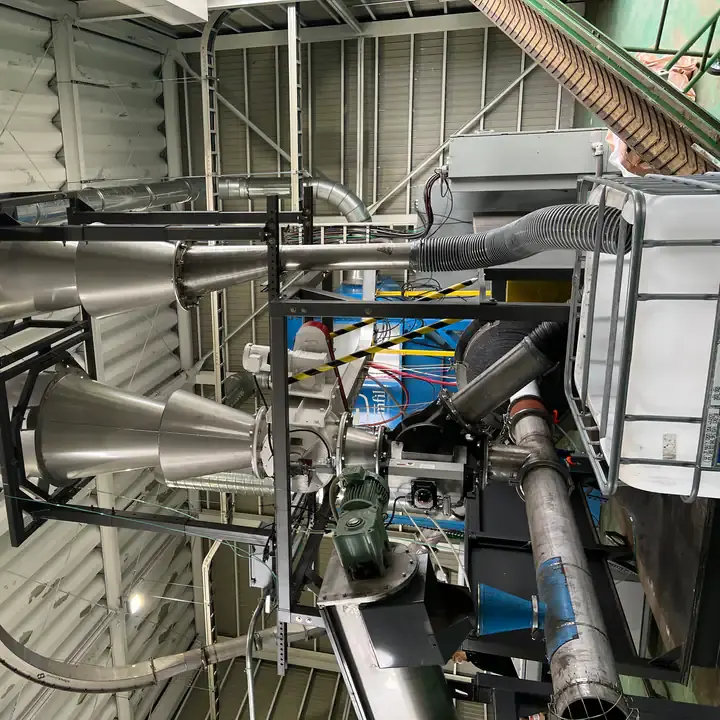
Shockwave’s particle size reduction technology micronizes raw biochar into a fine, consistent powder, ready to be incorporated into cement and concrete formulations. The process works across biomass-derived feedstocks — including corn stover and hardwood pellet biochar — giving manufacturers a stable, uniform product backed by verified particle size and elemental composition data.
How the Technology Works
- 01FeedRaw pyrolyzed biochar
- 02MillMicronize to concrete-ready fineness
- 03RecoverStable, characterized powder
- 01FeedRaw pyrolyzed biochar
- 02MillMicronize to concrete-ready fineness
- 03RecoverStable, characterized powder
Feed — Raw, pyrolyzed biochar enters the processing system, regardless of biomass feedstock.
Mill — The material is micronized to a fine, consistent particle size suited to cement and concrete applications.
Recover — Finished biochar exits as a stable, characterized powder, ready for packaging, testing, or blending into concrete formulations.
Have biochar you want micronized to spec?
Why Biochar Improves Concrete
- Strength — increases compressive and flexural strength
- Durability — improves performance, especially at high temperatures
- Carbon sequestration — reduces concrete’s overall carbon footprint
- Thermal conductivity — improves thermal performance
- Electromagnetic shielding — enhances shielding capacity
- Water permeability — reduces water permeability in the finished mix
How Biochar Is Used in Concrete
Biochar’s large surface area and high porosity help it absorb and release water during curing, which can speed the hydration process and improve mechanical properties. It can be used as a filler in cement paste and mortar composites, or as a partial substitute for cement powder in concrete mixes.
Verified Feedstocks
Shockwave offers micronized biochar from multiple biomass sources, each characterized through third-party elemental and particle size analysis:
Corn Stover Biochar
Carbon, hydrogen, and nitrogen content verified via high-temperature elemental analysis (ISO 16948); sulfur content verified via ISO 16994. Particle size distribution reports available on request.
Hardwood Pellet Biochar
Carbon, hydrogen, and nitrogen content verified via high-temperature elemental analysis (ISO 16948); sulfur content verified via ISO 16994.
Ready to Evaluate Your Material?
Every feedstock and application is different. Our team can review your biochar source, discuss your target particle size and performance goals, and determine the best path forward.
Next Steps
- Discuss your application
- Review particle size and composition data
- Evaluate your processing goal
Contact us to start the conversation.